Please note that some of the links on this website are affiliate links. I will earn a commission if you decide to make a purchase after clicking through the link. As an Amazon Associate I earn from qualifying purchases.
A Complete Winter Ingredient Compendium of the Pacific Northwest
Best Chef Recipes — Pacific Northwest Ingredient Series
Winter in the Pacific Northwest (PNW) is often misread from a continental perspective as a season of scarcity. In reality, the region’s maritime climate, cold-water ecosystems, storage technology, and perennial horticulture create one of the richest winter larders in North America. Rather than shutting down, the landscape shifts its biochemical strategy: plants sweeten under frost, roots concentrate sugars in storage, shellfish accumulate glycogen in cold water, and evergreen botanicals continue to produce aromatic secondary metabolites.
This article presents a structured overview of winter-available ingredients in the PNW, organized for chefs, growers, and culinary researchers. Ingredients are examined through the lenses of seasonal availability, biochemical change, and regional identity, with an emphasis on how winter conditions enhance flavor, texture, and gastronomic potential.
❄️ I. Fresh Winter Vegetation: Living Field Harvests
The maritime lowlands of the PNW—western Washington, coastal Oregon, and southern British Columbia—rarely experience sustained deep freezes. This allows for continuous harvest from overwintering crops whose physiology adapts to cold. Many species increase soluble carbohydrate concentrations as natural antifreeze, leading to heightened sweetness and reduced astringency during winter months.
🥬 A. Brassicas and Hardy Greens
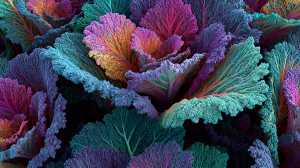
The Brassicaceae family dominates winter agronomy, providing structurally robust foliage with strong cold tolerance. These crops benefit directly from frost-induced sugar accumulation:
- Kale (curly, Lacinato, Red Russian, Siberian types)
- Brussels sprouts
- Savoy, green, red, and Napa cabbages
- Collard greens
- Mustard greens, mizuna, tatsoi, komatsuna
Physiologically, cold acclimation drives the accumulation of osmolytes—particularly glucose, fructose, and sucrose—as cryoprotectants. For the chef, this translates into objectively sweeter, less bitter brassicas in winter than from the same varieties grown under summer heat stress. Texture also shifts: leaves often become firmer yet more pliant, ideal for braising, grilling, and raw crudo-style preparations.
🧄 B. Overwintering Alliums and Aromatic Perennials
Alliums and hardy herbs form the aromatic backbone of winter cuisine, providing terpenoid and sulfur-derived aromatics that balance the density of winter starches and fats:
- Leeks (field-harvestable throughout winter)
- Green onions and scallions (often from hoop houses or low tunnels)
- Hardy parsley (Petroselinum crispum)
- Perennial aromatics: thyme, rosemary, oregano, sage, winter savory, bay Laurel
These species maintain essential oil production through the cold season, offering high-intensity aromatics at a time when many annual herbs have senesced. Their role is not ornamental; they provide structural balance, cutting through veloutés, gratins, braises, and confits with volatile compounds that reset the palate between bites.
📦 II. Stored Field Crops: Technology-Extended Seasonality
Winter in the PNW is equally defined by storage practice. Late-autumn harvests are transformed into winter ingredients through controlled-atmosphere (CA) refrigeration, cellar-like humidity regimes, and in-ground overwintering. These methods convert autumn abundance into winter reliability.
🥕 A. Root Vegetables and Tubers
- Carrots
- Parsnips
- Beets (red, golden, Chioggia)
- Turnips and rutabaga
- Celeriac (celery root)
- Potatoes (russet, Yukon Gold, fingerling, purple)
- Jerusalem artichokes (sunchokes)
- Daikon and winter radishes
As soil temperatures fall, starch hydrolysis in these roots increases soluble sugar content. Post-harvest, slow respiration in storage continues this transformation. Properly managed cellars and CA rooms therefore function as flavor laboratories, yielding roots that are sweeter, denser, and more aromatic in midwinter than at harvest.
Culinary applications include puréed veloutés, slow-roasted root medleys, lacto-fermented salads, root confits in fat, and gratins that draw on both starch and natural sugars for structure and browning.
🎃 B. Winter Squash and Pumpkins
- Kabocha (green and red)
- Butternut
- Delicata
- Acorn and Carnival
- Spaghetti squash
- Sugar (pie) pumpkins
These cucurbits are harvested in early autumn but reach peak flavor in storage. Starches slowly convert to sugars, cell walls dehydrate slightly, and flavors concentrate. By midwinter, a well-cured squash expresses sweetness and depth suitable for high-end purées, gnocchi doughs, custards, and roasted garnishes that anchor the plate.
🍎 C. Stored Orchard Fruit
- Apples (Honeycrisp, Fuji, Gala, Pink Lady, Jazz, and regional cultivars)
- Pears (Comice, Bosc, Anjou)
- Cranberries (coastal bogs of Washington and Oregon)
- Frozen local berries (blueberry, blackberry, marionberry, raspberry)
Controlled-atmosphere (CA) storage modulates oxygen, carbon dioxide, and humidity to slow respiration and maintain textural integrity. In a technical sense, CA facilities become an extension of terroir: autumn fruit remains authentically local and seasonal in midwinter, preserving acidity, aromatics, and crunch for both savory and pastry applications.
🌰 D. Regional Nuts
- Oregon hazelnuts (filberts)
Hazelnuts are a winter cornerstone, providing fat, phenolic complexity, and textural counterpoint. They function as both garnish and structural element—forming crusts for fish, poultry, or root roasts; thickening sauces and pestos; and bringing roasted depth to desserts aligned with pears, apples, chocolate, and coffee.
🌊 III. Cold-Water Seafood: Biological Winter Peak
Marine ecosystems invert the logic of terrestrial winter scarcity. As water temperatures drop, microbial activity declines and many species shift toward energy conservation. Glycogen retention in shellfish and fat storage in fish generate peak texture and flavor in winter.
🦀 A. Crustaceans
- Dungeness crab (Metacarcinus magister)
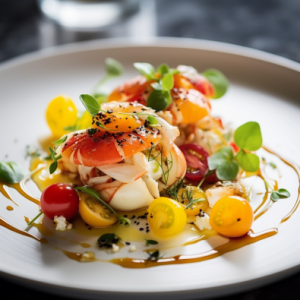
Dungeness crab peaks from late fall through winter. Cold water after molt allows crabs to “fatten” with high meat-fill percentages and sweet, briny muscle. For chefs, this is the optimal window for clean crab flavor with minimal off-aromas. Applications include butter-poached crab, chilled crab crudo with citrus, crab bisque, and crab integrated into winter vegetables such as leeks, fennel, and kabocha.
🦪 B. Bivalves and Mollusks
- Pacific oysters
- Olympia oysters (Ostrea lurida)
- Kumamoto oysters
- Manila clams, littlenecks, mussels
Cold water induces metabolic conservation and glycogen accumulation in bivalves. Winter oysters are notably creamy, sweet, and texturally firm, widely considered the prime season for raw consumption. For the kitchen, this is the moment for simple, precise treatments: raw on the half shell, lightly poached in vermouth and cream, grilled with evergreen aromatics, or paired with acid-forward mignonettes built from winter citrus and preserved fruits.
🐟 C. Finfish
- Black cod (sablefish)
- Locally caught and frozen sockeye and Chinook salmon
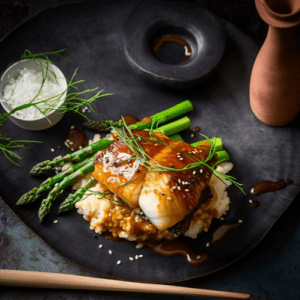
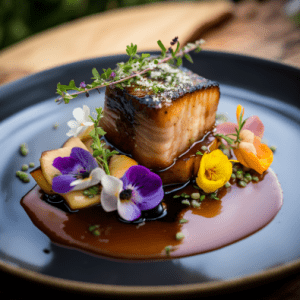
While salmon runs are primarily autumnal, winter cuisine leans on high-fat cold-water species that excel in curing, smoking, and miso-based roasting. Black cod’s elevated lipid content and delicate flake make it ideal for long marinades and low-temperature cooking, creating a bridge between Japanese, Nordic, and PNW culinary vocabularies.
🌲 IV. Wild and Foraged Winter Foods
The PNW’s humid, maritime climate keeps biological processes active even in midwinter. While growth slows, it rarely halts. Fungal, intertidal, and evergreen systems continue to offer ingredients that express bitter, resinous, and mineral dimensions often absent from industrial winter supply chains.
🍄 A. Fungi
- Winter chanterelles (Craterellus tubaeformis)
- Hedgehog mushrooms (Hydnum repandum)
- Oyster mushrooms (Pleurotus spp.)
- Velvet shank (Flammulina velutipes)
These species favor cold, wet environments and decomposing forest substrates. Texturally, they offer delicacy and resilience; aromatically, they contribute forest floor, nutty, and slightly fruity notes. Their role in winter menus includes broths, ragùs, mushroom confits, and as primary partners to roots, grains, and game.
🌊 B. Intertidal and Botanical Forage
- Sea lettuce and kelp (harvest subject to regulation and water quality)
- Wild mussels and barnacles (collected with appropriate safety and legal considerations)
- Conifer needles (Douglas fir, spruce)
- Rose hips
- Coastal evergreen huckleberries
- Wild burdock and dandelion roots
These ingredients enable chefs to introduce bitter tonics, mineral umami, and resinous evergreen aromatics into winter compositions. Douglas fir and spruce needles express citrus-adjacent, resin-driven top notes; rose hips and evergreen huckleberries contribute acidity and tannin; burdock and dandelion roots extend the language of roots into more medicinal, tonic directions.
🧭 Conclusion: A Winter Terroir of Sweetness, Brine, Fat, and Resin
The winter larder of the Pacific Northwest is not defined by absence but by intensification. Frost-sweetened roots, fat-rich fish, glycogen-loaded shellfish, resinous herbs, and storage-concentrated fruits together create a regional dialect built on contrast:
- Sweet starch vs. saline brine
- Cold-fat richness vs. evergreen aromatics
- Stored autumn abundance vs. living winter vegetation
This dialect is both agricultural and ecological. It emerges from a bioregion where moderate temperatures blunt the severity of winter, where persistent moisture sustains decomposition and fungal activity, and where cold coastal waters reach their culinary peak precisely when terrestrial systems appear dormant.
For chefs, this compendium can serve as a framework for tasting menus, pantry design, and research-driven seasonal cooking. For academics and culinary students, it provides a model of how climate, storage technology, and ecology converge to shape winter terroir in a specific bioregion.
Next in the Series
In future installments, we will translate this winter ingredient map into practice by exploring:
- A full winter tasting menu expressing sweetness, brine, fat, and resin across multiple courses
- Technical tables and matrices linking ingredient biochemistry to cooking methods and flavor pairings
Use this compendium as a starting point to design your own PNW winter narrative—on the plate, in the cellar, and at the shoreline.